

Before Children Build Knowledge, They Build a Mental World Rich With Ideas
How stories, nature, conversation, and imaginative play help young children build the mental framework that supports lifelong learning.

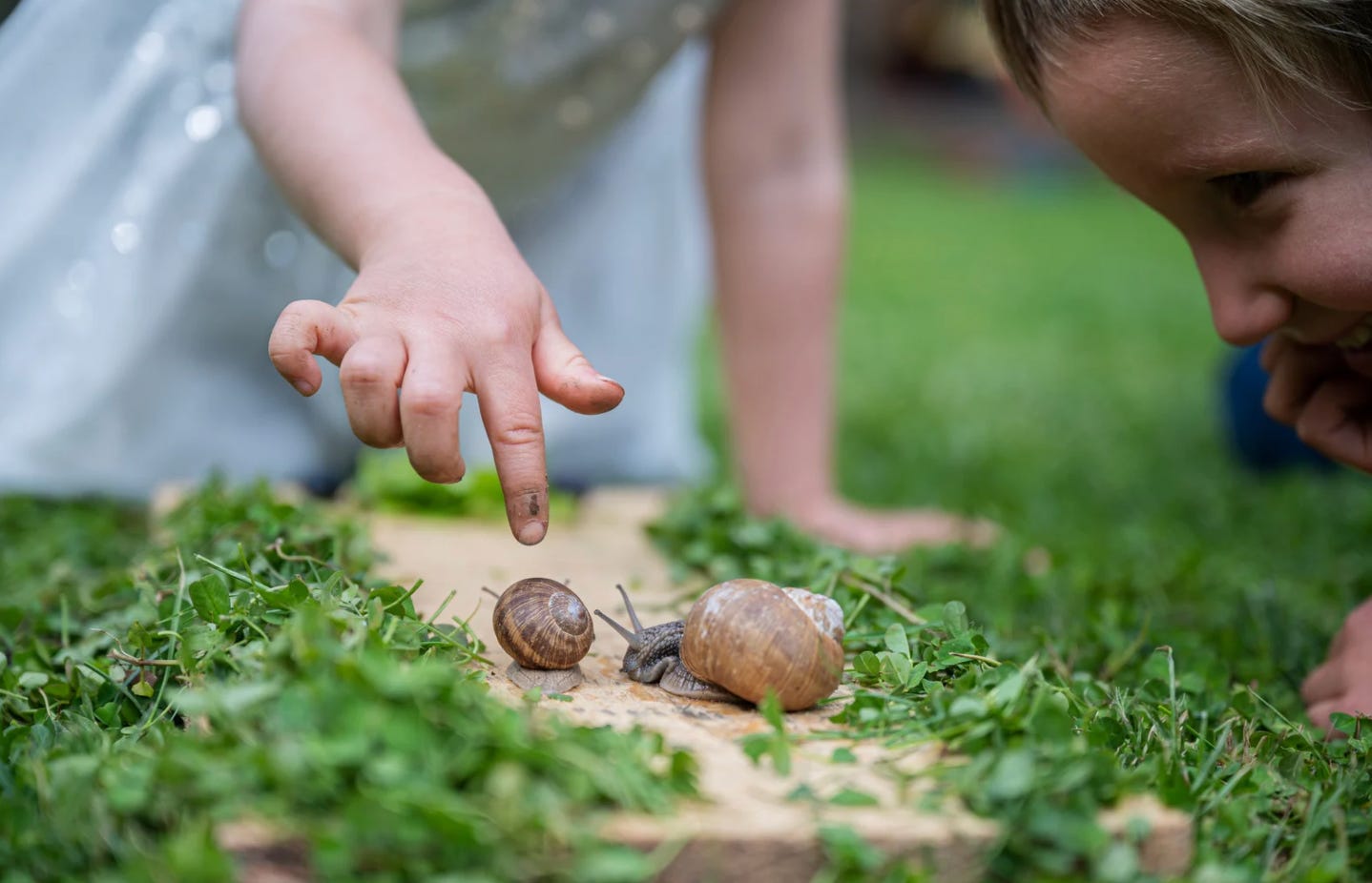
If you walk into the backyard on an ordinary afternoon, you might find your four-year-old sitting cross-legged in the dirt, completely absorbed in a project.
To most adults, what they are doing looks haphazard.
They have mixed dirt and water to form a small mud hut. They have padded the edges with grass, stuck a few clover flowers into the roof, and carefully placed three shiny glass beads near the entrance. Inside the hut sits a single garden snail, completely retreated into its shell.
At first glance, it’s just a cute pastime—something to smile at before telling them it’s time to wash up for dinner.
I’ve been thinking about this image all week while working with a progressive school that refuses to dismiss this kind of activity as “just play.” They see it as the very beginning of how children build their mental world.
They understand a fundamental truth about development.
Children don’t think in subjects. They make meaning through experiences.
Long before they ever encounter formal curriculum, children are busy weaving those experiences into an interconnected web of ideas.
And if we want them to grow into truly deep thinkers, our job isn’t to rush them into accumulating knowledge. It is to protect the landscape where that knowledge has to live.
The Human Questions in the Dirt
When my daughter was little, she would spend hours making mud pies in kid-sized metal pots, topping them with stone berries and serving them alongside cups of imaginary tea.
It is easy to relegate that kind of play to the category of simple entertainment. We assume that the serious business of learning will start later, when they are old enough for worksheets and reading groups.
But look at what is actually happening inside a child’s mind when they build a home for a snail. They aren’t trying to rehearse school subjects. They are exploring deeply human, anthropological questions:
Adults see dirt. The child sees home.
Adults see a snail. The child sees a living creature that needs shelter.
Adults see decoration. The child sees care made visible.
The snail becomes the occasion for exploring these massive, foundational concepts: What makes a home? Where do living things belong? Can beauty exist alongside function?
The ideas flow across space and time freely, connecting effortlessly because that is how children experience life.
Subjects are a perfectly fine tool for organizing a school day. But they are a terrible map of how a young mind actually learns.
The problem occurs when we begin to believe that these artificial silos are how a child’s mind naturally constructs understanding.
Why Knowledge Needs Somewhere to Live
Knowledge without ideas is fragile.
When a child memorizes facts or procedures before they understand the underlying concept, that information has nothing to hold onto. It often fades because it never became part of a larger web of meaning, particularly a web your child built themselves from their own understanding.
When we force children to abandon their integrated view of life and fit their thoughts into isolated academic boxes too early, we don’t accelerate their learning.
We give them fragments of information before they have built the conceptual hooks required to hold them.
Knowledge becomes powerful only when it has a meaningful structure to attach to, a web of interconnected concepts and ideas.
A Connected Mental World
Nurturing this native way of thinking doesn’t require buying specialized educational toys or organizing endless, structured activities.
It requires an idea-rich environment.
This isn’t a space filled with expensive gear; it’s an environment where stories, nature, conversation, observation, history, and everyday life continually feed one another, helping a child build a connected mental world.
Think about a typical walk through the woods. We can treat a walk as pure exercise—a way to get from point A to point B. But when you walk with a child, the forest becomes a living tapestry.
You pause by a fallen log. You observe which trees have moss growing thick on the north side, which ones don’t, and you talk about why. My kids and I did this regularly. And invariably that initial observation naturally sparked a memory of say an Irish folktale we’d read aloud at breakfast a few days ago. Which led to a discussion about how Native Americans understood the land, navigating forests without maps because they knew how to listen to the environment. Which easily might lead to looking at the width of the trunk, guessing how old the tree might have been when it fell, and wondering about the age of the surrounding forest.
This isn’t a structured lesson plan. It is a habit of mind. This is how children naturally build understanding…by allowing one idea to call forth another.
When you read a wide range of folktales, myths, history, and literature aloud, and then take those stories out into the world, you are handing your child the raw material for deep thinking.
When they encounter science, history, or art on that walk, they aren’t seeing separate subjects or data points to be memorized for a test.
They are seeing different facets of the exact same human experience. They learn to ask “What if?” and “Why?” because they are genuinely invested in the narrative of the world around them.
The Roots of Independent Thinking
Kids who grow up in a connected mental world don’t expect learning to arrive in separate boxes. They instinctively look for relationships… just the way they did as toddlers. They ask why one thing reminds them of another. They assume ideas belong together.
Now think about it… the adults we admire for original thinking—scientists, writers, designers, entrepreneurs, historians—share this same habit.
They notice patterns and connect ideas other people overlook. Innovation never comes from mechanical compliance. It comes from having a rich, deeply rooted internal landscape to draw upon.
If that habit of wondering gradually gives way to an education built primarily around correct answers and isolated facts, rebuilding that richly connected mental world later becomes much harder.
When a child spends their early years collecting evidence that the world is a connected, meaningful place to be explored, they carry that landscape with them into adulthood.
When they hit a difficult math problem, a complex historical text, or a challenging lab experiment years down the road, they don’t throw their hands up in frustration. They treat it the same way they treated the snail house or the moss on the fallen tree: as a puzzle to be untangled, a story to be understood, and an experience to be owned.
The Gift of Ideas
Instead of worrying about whether your young child is meeting a specific academic benchmark or finishing a prescriptive workbook, look at the ecosystem of your home.
Ask yourself what kind of raw material is floating around their environment.
Are there stories being read aloud that stretch their vocabulary and imagination? Are there spaces where they can sit in the dirt and be completely serious about a game that makes no sense to an adult? Do you have time to pause on a walk and muse about where an animal lives or how old a tree is?
Our job in these early years isn’t to fill a bucket with isolated facts.
Every time you read an old myth, every time you sit on the grass and look closely at a butterfly without rushing away, and every time you take their pretend play seriously, you are helping them build their foundation.
On an ordinary Tuesday afternoon, they aren’t just making mud pies. They are building a web of knowledge, how ideas and things in the word around them connect; they are building the infrastructure of their minds.
Children don’t become deep thinkers because they accumulate more knowledge. They become deep thinkers because they spend years building a rich web of ideas, and those ideas are what make future knowledge permanent and useful.
Long before children are ready for formal knowledge, they are quietly building that place where that knowledge will one day live.